
By Tom Adams · Tom Adams Research
The day after the Trump administration’s rescheduling hearing wrapped on July 15, the industry’s traditional Democratic friends put full descheduling back into play, reintroducing the Cannabis Administration and Opportunity Act that Senators Schumer, Booker and Wyden first floated in 2021.
The press coverage framed CAOA as long-hoped-for legislative descheduling, contrasting it to the executive branch’s mere rescheduling, but few reporters mentioned the 25%-of-wholesale federal excise hiding in Title IV like the asp in Cleopatra’s basket of figs. Our analysis suggests it could be just that deadly.
The 25% rate the bill schedules for year five is levied on what CAOA calls the producer’s “removal price,” or wholesale price, so after the typical 100% retailer mark-up it would amount to roughly 12.5% of what the consumer pays. Added to state excise taxes that average about 15% of consumer prices across the adult-use states in our recent survey, the typical load on every product legal stores sell would reach 27.5% of retail. And that’s before the general sales tax most states also charge.
That is the punitive neighborhood into which governments have hiked tobacco taxes to discourage use of America’s number one cause of preventable death. At the extreme, in Washington state, the load would approach 50% (see graph), not including Washington’s average state/local 9.4% sales tax. But beyond year five, it gets even worse for consumers, and the industry.
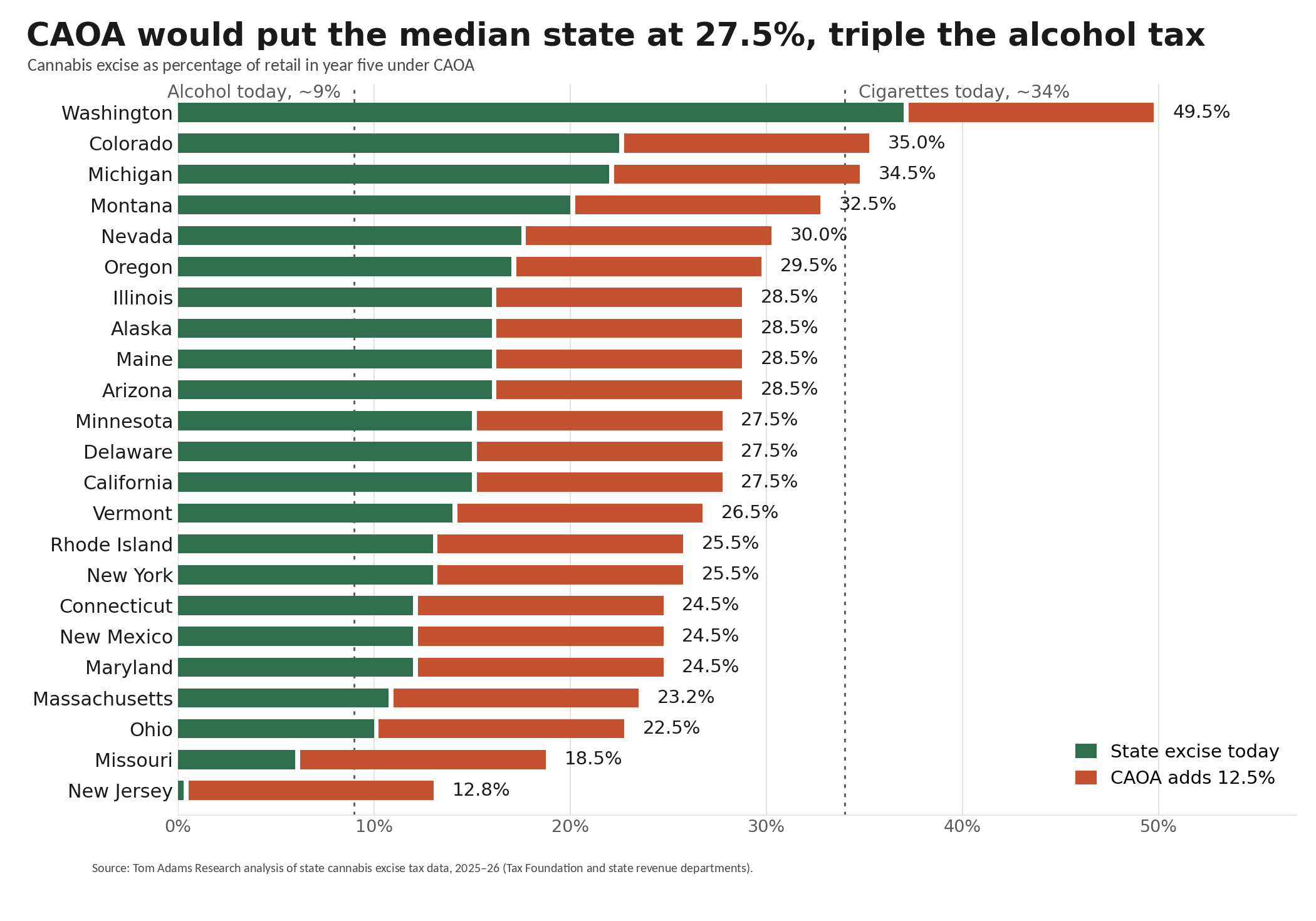
Kicking the market when it’s down
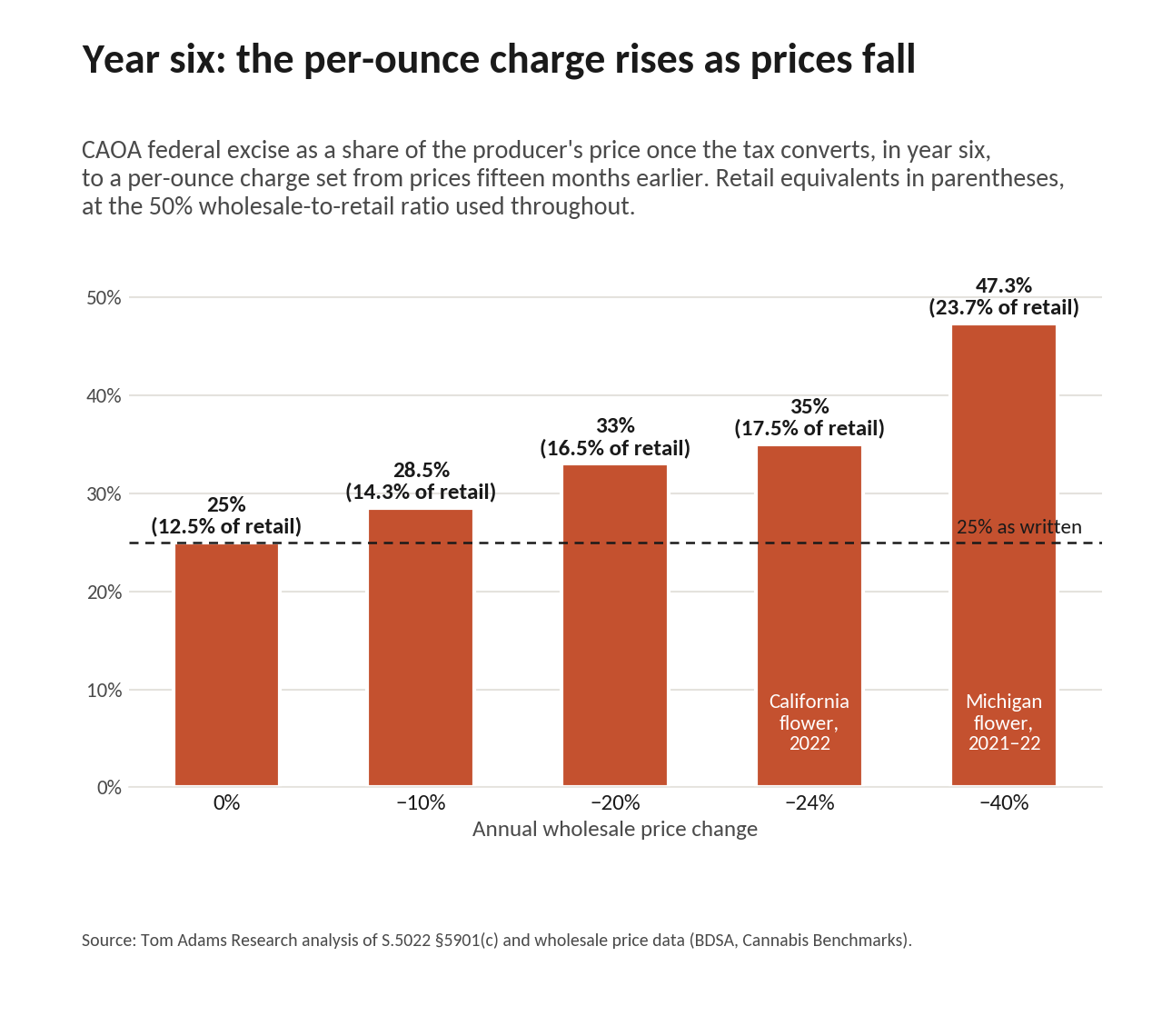
In year six, the tax converts from a percentage of the current removal price to a per-ounce charge on flower and a per-gram charge on the THC in everything else, which Treasury resets each year at 25% of the prevailing price over the twelve months ending a quarter before the year begins.
Given the history of prices collapsing in emerging cannabis markets, the tax bill would thereby swell as a percentage of the producer’s price just when operators could least afford it. If wholesale prices fell 10% in a given year, the charge would run 28.5% of the producer’s current-year price; at the 24% annual decline California flower recorded in 2022, a pace commonly seen elsewhere, it would hit 35%.
The worst price-erosion case on record is Michigan, where wholesale flower fell two-thirds in under two years (from about $2,750 a pound in January 2021 to $925 in October 2022); at that roughly 40%-a-year pace, the federal charge alone reaches 47% of the producer’s price.
California and Michigan probably won’t see 24% and 40% annual price declines again, but newer markets probably will. If they have today’s median state excise rate of 15% of retail, price erosion like California’s would make the combined federal and state burden 32.5% of retail in a bad year. If price erosion as severe as Michigan’s happens, the combined load could be 38.7% of retail.
Taking what they can get
Legalization advocates have always taken what they could get from regulators, then worried about the market’s economics afterward. That is how Washington ended up with a 37% excise and how California ended up with local opt-out rules that leave it just 32 licensed storefronts per million residents. Both were the result of pre-legalization negotiation in which industry advocates were forced to cede ground to get legalization rolling. But now it is clear how such concessions can cripple the industry.
Clearly, descheduling needs to be next on the industry’s agenda whatever the DOJ decision on adult-use rescheduling. Interstate commerce, ordinary banking and capital markets, conviction expungement and an exit from the Controlled Substances Act are worth a great deal, and rescheduling by itself delivers none of them, just a cancelling of the Section 280E penalty.
But taking whatever terms regulators offer had to stop someday, and the moment the industry’s leading supporters suggest cannabis should be taxed like tobacco should be that moment. In an “Only Nixon Could Go to China” moment, a Republican executive branch has just decreed state-licensed medical cannabis a Schedule III substance and argued to an administrative law judge that marijuana “has a currently accepted medical use.” With that on the record, the terms of any federal descheduling move deserve a careful look.
Not trying to discourage use
Its sponsors didn’t mention the tax lest it be seen as a simple money grab aimed at an unpopular splinter group of Americans. But two surveys out this summer show that old stereotype no longer holds.
Fifty-four percent of adults drink, 11% smoke cigarettes, 17% smoke cannabis, and 15% eat it (per Gallup). Moreover, 21.4 million use cannabis daily or nearly so, more than the daily cigarette smokers or the daily drinkers (per SAMHSA): cannabis has gone mainstream while alcohol use is dropping and cigarette smokers are the shunned splinter group now.
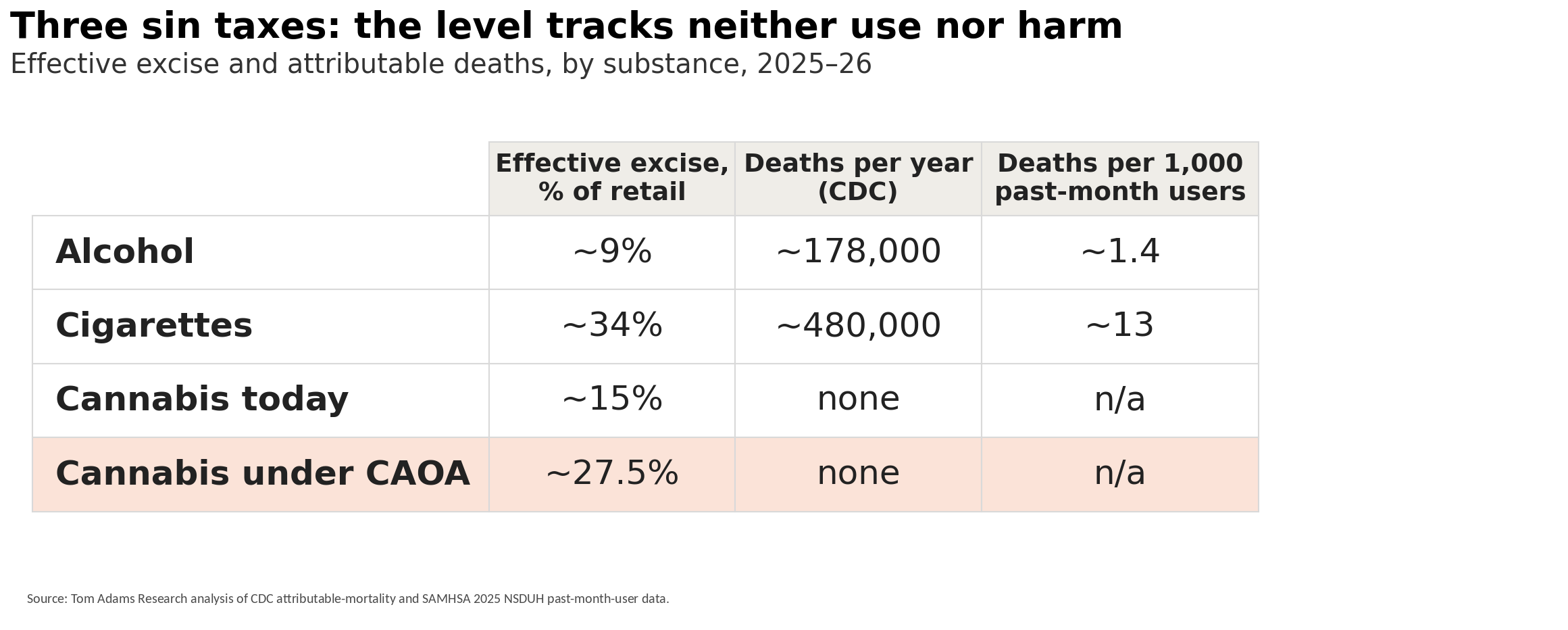
It can’t be argued that the combined state-federal tax levels fit the harm profiles (see table), which is the explicit reason for taxing cigarette smokers at rates more than three times what alcohol drinkers pay (see table). The government attributes about 480,000 deaths a year to smoking and 178,000 to excessive drinking, none to cannabis, and has just argued in its own rescheduling hearing that the product has medicinal value. Cigs and booze do not, and they cost governments well over $200 billion a year in healthcare and other costs.
Now that science is paying attention, the CDC will someday add cannabis to its “attributable mortality” tracking, and we’ll see if it falls inside or below the range set by alcohol (1.4 per 1,000) and tobacco (13 per 1,000). Meantime, given the modest size of the legal cannabis business, a federal cannabis excise tax would amount to a rounding error in DC’s budget: the Yale Budget Lab, modeling one in August, put the take at $57.9 billion over ten years, about $5.5 billion a year, or three-tenths of one percent of this year’s deficit.
How to guarantee the illicit market survives
No reason to punitively tax cannabis survives a confrontation with the simple idea that, at a 27.5% excise load, the legal channel would struggle to capture the rest of total cannabinoid sales. Cannabis consumers already have the option every excise-tax designer seems to ignore. The illicit trade is still worth $43 billion against $31 billion of licensed sales, per BDSA.
Congress has faced exactly this conundrum once before and did the right thing. It set the 1934 liquor tax low on purpose, to let legal distillers compete with a bootleg trade that still supplied two of every five gallons Americans drank after Prohibition ended.
The recent substantial increases in tobacco taxes show what happens when high excise taxes create space for illicit operators. In California and New York, more than half the cigarettes consumed are smuggled in from lower-tax states, according to the Mackinac Center. The recent Yale report concedes that high federal rates could “inadvertently reinforce illicit competition.” No kidding.
CAOA vs. STATES
The third potential argument for a federal excise tax would be paying for whatever regulatory and enforcement costs Washington would take on with descheduling. But what are those going to be? Twenty-three states already run licensing, testing and tax regimes and pay for them out of that median 15% excise. DC need play no bigger a role than it plays in alcohol.
The House alternative to CAOA, the STATES 2.0 Act, also would deschedule and open interstate commerce with no federal excise at all; it has been on the table in one form since 2018 and still has not had a committee hearing. The two bills diverge mainly on the excise tax issue (see table).
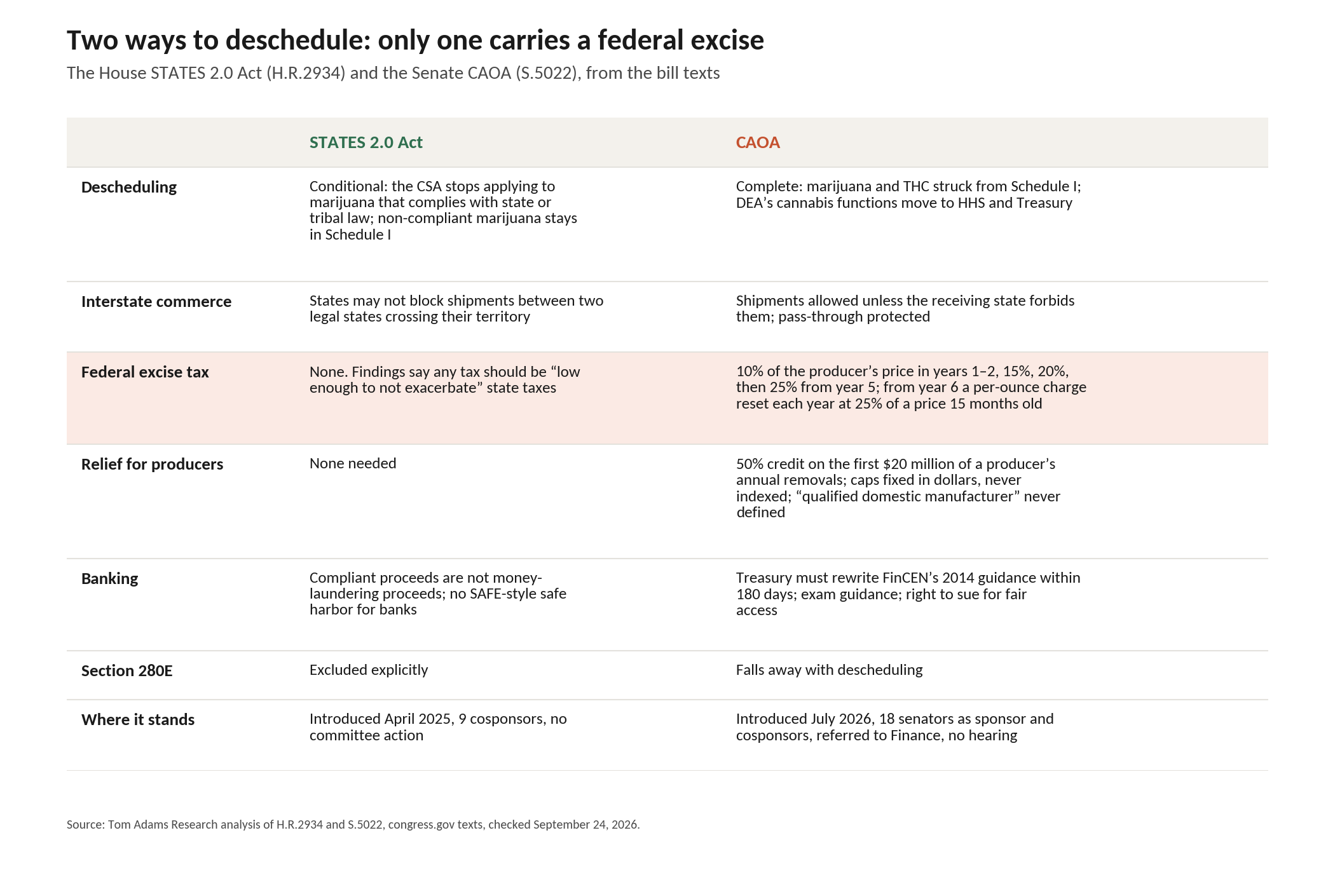
In a CAOA world, every business plan would have to carry a federal excise climbing to 12.5% of retail by year five (and a per-ounce charge from year six set against its own price forecast), and thus show thinner after-tax margins. But the real impact would be at the revenue line as the state markets contract.
The smart move for the industry is patience in the short term while planning ahead to emulate what the alcohol business has done all these years: show up for every hearing, accede to reasonable safety, packaging and advertising rules, and enlist consumers against tax levels that will either cost them money or keep them buying illegally. Alcohol’s key advantage over the years was a distributor in every congressional district; cannabis has a licensed store in about three out of four, with more coming.
Three things to watch: the administrative law judge’s recommendation on adult-use rescheduling and DEA Administrator Terrance Cole’s decision on it; any Senate Finance Committee date for S.5022; and any House movement on STATES 2.0, which picked up its ninth cosponsor in August.
Much will hinge on who controls which houses of Congress next year.
Meanwhile, 280E relief through rescheduling could arrive without a federal excise tax. STATES would complete the descheduling arc without adding to the state-level 15% load under which cannabis already labors.
CAOA as written would impose a punitive tax that is certain, permanent, and designed for a deadly product the government wants less of. That’s not cannabis, and the legal industry can’t afford to let DC treat it like it is.
TOM ADAMS is President and Principal Analyst at Tom Adams Research, and has covered cannabis markets since 2016. He was previously Managing Director of BDSA’s Industry Intelligence group and Editor-in-Chief of Arcview Market Research. Tom Adams Research advises operators, investors and regulators on where cannabis markets are going and which regulatory regimes produce healthy ones. adamsresearch.net